FIFA President Gianni Infantino has said Nigeria is not currently equipped to host the men's FIFA World Cup, pointing to major infrastructure requirements that would need to be addressed before a future bid.
Speaking during an interview with ARISE News in Abuja on Monday, November 23, Infantino acknowledged Nigeria's footballing passion and potential while identifying shortcomings in facilities and transportation.
Hosting a World Cup requires considerably more than suitable football stadiums. Organisers must demonstrate adequate airport capacity, transport connections, accommodation, security arrangements and the ability to manage large international crowds.
Infantino's comments followed a visit to Nigeria during which he also examined football development projects, including infrastructure associated with the Nigeria Football Federation.
Although Nigeria has a significant football culture and a record of hosting international competitions, successfully staging a men's World Cup would involve extensive investment and long-term planning.
The broader question is whether future investment in sports infrastructure can also produce lasting benefits for Nigerian communities, domestic competitions and youth football development.
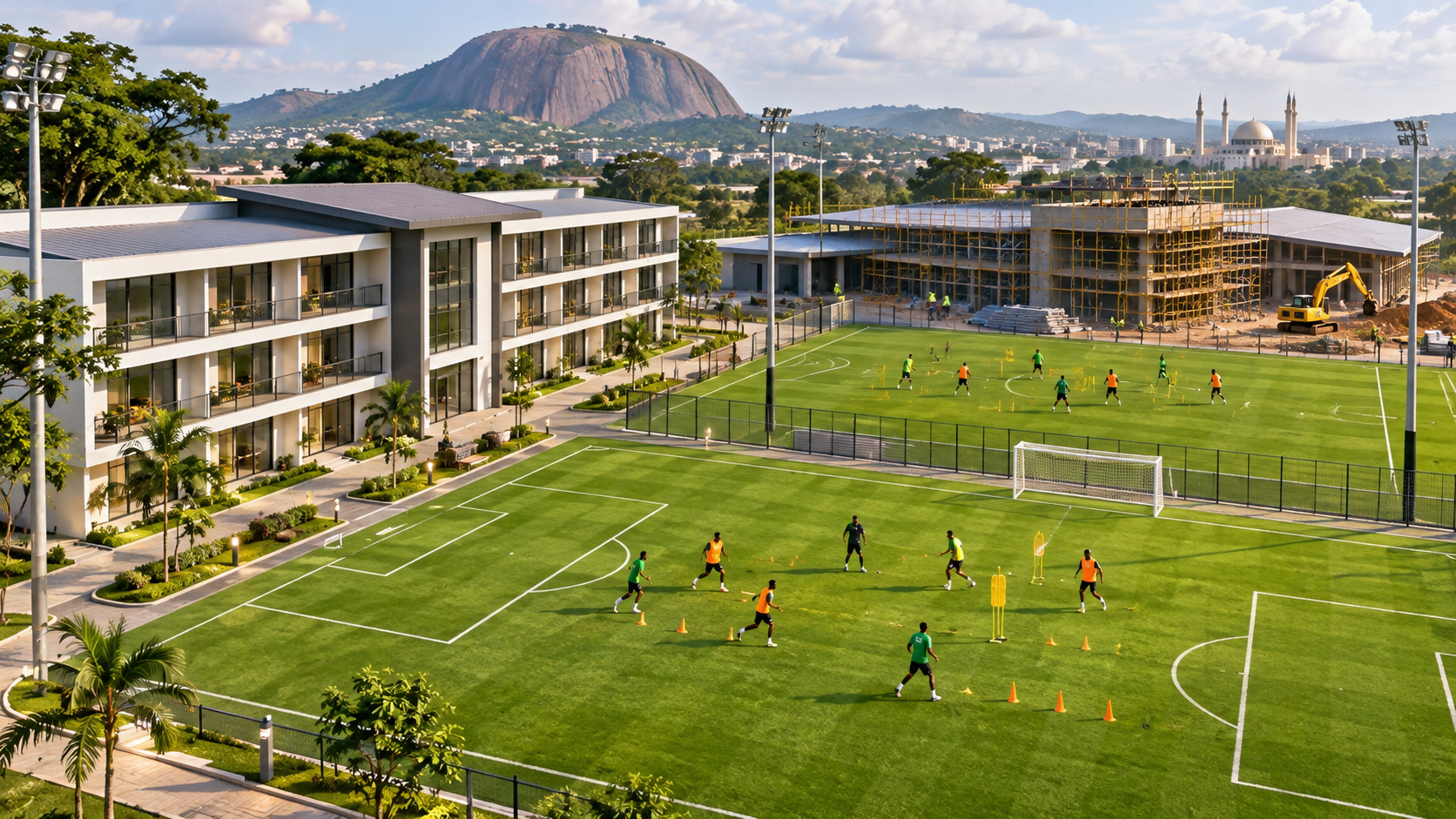
Illustration: NaijaFeed. Artistic impression of a football training complex, not a depiction of the completed Abuja project.
FIFA President Gianni Infantino has inspected a new football training and accommodation complex under construction in Abuja, highlighting an infrastructure project intended to support Nigeria's national teams and young players.
The facility, located at the MKO Abiola National Stadium, is being developed through FIFA's Forward programme in partnership with the Nigeria Football Federation (NFF).
Infantino visited the site on Friday, November 20, during a trip that also included the renovated Warri City Stadium in Delta State.
What is being built in Abuja?
According to FIFA, the new technical centre will include a 68-room accommodation wing for players, along with a kitchen, restaurant, meeting rooms, a sauna and other supporting facilities.
The project also includes two new training pitches, changing rooms for players and officials, and spectator terraces with seating for 1,838 people.
Construction began in March 2025, and the complex is expected to serve as a base for Nigeria's national teams once completed.
The NFF reported that work on the natural-grass training pitch had reached approximately 60 percent completion at the time of Infantino's visit.
That figure refers to the pitch's progress and should not be interpreted as a completion percentage for the entire development.
The federation said drainage systems and other essential groundwork had already been installed.
Investment in Nigeria's football future
Training infrastructure is a longstanding challenge for developing national football programmes.
Suitable pitches, accommodation and support facilities can reduce logistical difficulties and provide more consistent environments for athletes preparing for international competitions.
The Abuja centre is intended to support different levels of Nigerian football, including men's and women's national teams, youth development and grassroots activities.
Its longer-term value will depend on how the complex is maintained, who can access it and whether it is integrated into sustained player-development programmes.
Infantino also visits Warri
During the same trip, Infantino toured the renovated Warri City Stadium alongside Delta State Governor Sheriff Oborevwori.
FIFA said the upgraded venue includes a hybrid-grass football pitch, an athletics track, swimming pool, indoor sports facilities and improved drainage.
The two projects represent different approaches to sports infrastructure: one focused on a dedicated national-team training base, the other on rehabilitation of a multipurpose stadium.
For the NFF, completing the Abuja complex is only the first major test.
Ensuring that the facilities remain operational, accessible and useful to successive generations of Nigerian players will determine whether the investment achieves its promise.
Rivals Nigeria and Cameroon found themselves at the opposite ends following the draw for the final tournament of the Under-17 Africa Cup of Nations Tanzania 2019.
FIFA has withdrawn its threat to ban Nigeria from international competition. It brings to an end a football crisis that began four years ago. FIFA says it has assurances that the legitimate leadership of Nigeria's football federation has been restored and is in full control of its offices.
Nigeria has narrowly escaped an international football ban after its government responded to a FIFA ultimatum shortly before a suspension took effect on Monday.
FIFA had issued a statement saying it would suspend Nigeria at 11 am GMT Monday because of a power struggle over the leadership of the Nigeria National Federation, known as the NFF.
Amaju Pinnick was elected head of the NFF in 2014. However, while he was at the World Cup with Nigeria's Super Eagles team, another faction took over the federation's headquarters.
The faction was led by sports administrator Chris Giwa who says he is the rightful leader because of a court ruling in his favor earlier this year.
Nigeria's Sport Minister Solomon Dalung, acting on the court ruling ordered Pinnick and his board to comply with the court and leave the NFF, according to local media reports.
However, faced with a FIFA ban for government interference, Nigeria on Monday rejected Giwa's claim to leadership and backed Pinnick instead.
The vice president's media aide, Laolu Akande earlier tweeted: "The FG has already conveyed to FIFA its firm position recognizing Amaju Pinnick-led NFF as the current and only NFF Exco,"
FIFA later released a statement saying: "FIFA received confirmations that the legitimate leadership of the NFF under President Amaju Melvin Pinnick and General Secretary Mohammed Sanusi has been given back effective control of the NFF and its offices."
It is not the first time that Nigeria has faced a FIFA ban over government interference.
FIFA suspended the country when a high court ordered the NFF to hand over the reins of the national team to a government civil servant after the country's exit from the 2014 World Cup in Brazil.
Football is a much-beloved sport in the country, but poor showings at international tournaments by the Super Eagles team have often inspired calls for change and prompted successive governments to interfere in the administration of the sport, a clear breach of FIFA rules, which does not accept government interference in football.
The footballing ruling body says it will continue to monitor the situation in Nigeria to make sure "FIFA rules and regulations are fully adhered to."
Monday is deadline day for Nigeria to sort out the running of its Football Federation. Otherwise, the country shall be banned by FIFA. Soccer's governing body has taken issue with how much the state has allegedly interfered in the running of the Nigerian Football Federation. Amaju Pinnick, who is recognized by FIFA, and his team were kicked out of the NFF and a rival faction, led by Chris Giwa has taken control. Giwa is under a five-year ban by FIFA for breaches of the NFF statutes and the FIFA code of ethics handed in February last year. But he appears to have the backing of the Nigerian government.