Tuesday, November 24, 2026

SERAP Sues INEC Over Suspected AI-Generated Photos in Nigeria's Voters' Register

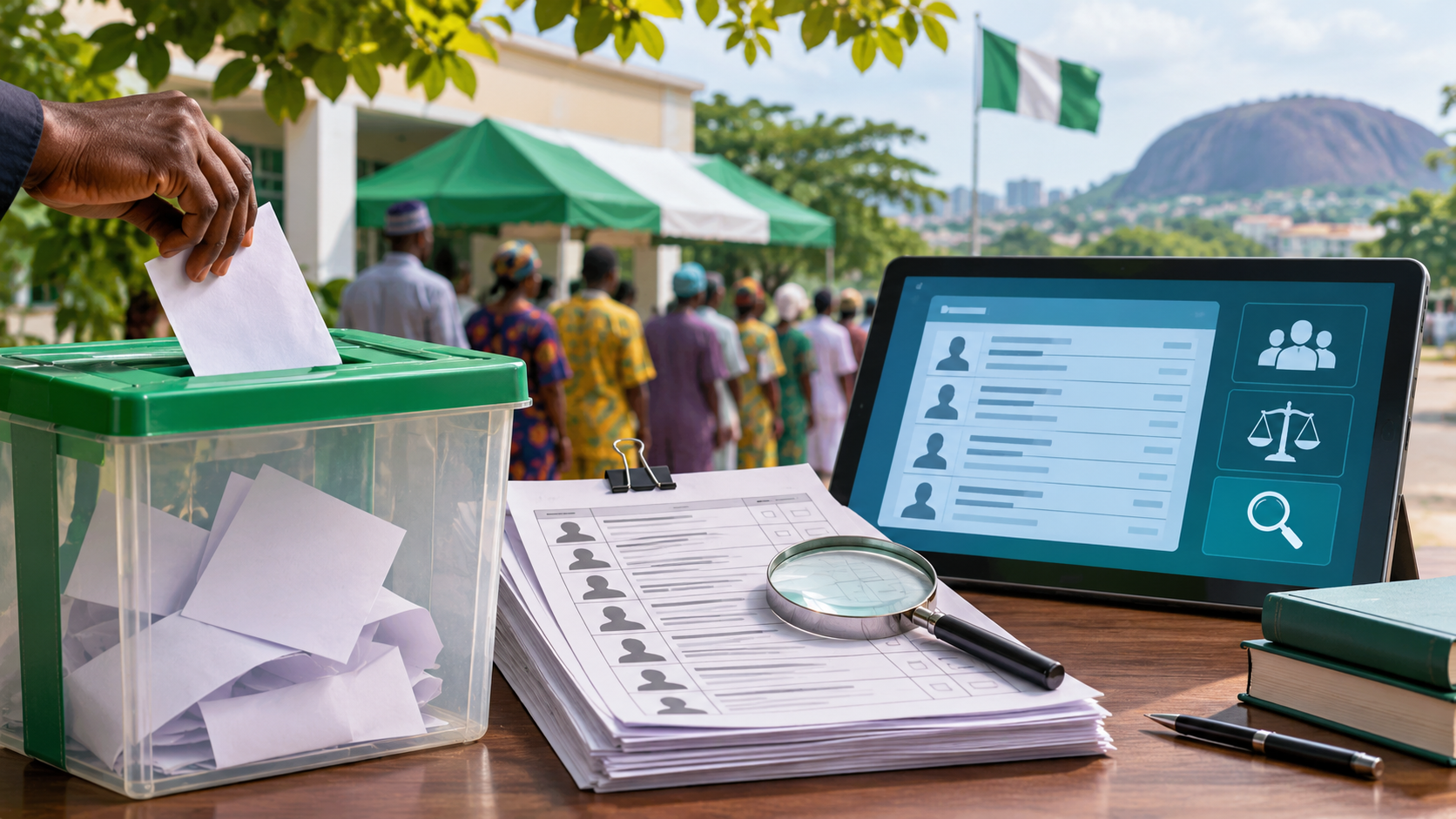
Illustration of a ballot box, paperwork and a tablet at a Nigerian polling station.
Illustration: NaijaFeed. Conceptual depiction, not an INEC database screenshot.

Nigeria's preparations for the 2027 general elections are facing renewed scrutiny after the Socio-Economic Rights and Accountability Project (SERAP) filed a lawsuit over suspected artificial intelligence-generated photographs and other irregularities in the preliminary voters' register.

The lawsuit, filed at the Federal High Court in Abuja under suit number FHC/ABJ/CS/2863/2026, names the Independent National Electoral Commission (INEC) and the Nigeria Data Protection Commission (NDPC).

SERAP wants the data protection regulator to independently examine the disputed records and determine whether Nigeria's data protection laws have been breached.

What triggered the lawsuit?

The controversy follows disclosures by INEC about questionable entries in its preliminary voter register, including photographs suspected of being artificially generated.

SERAP's account of an earlier disclosure refers to 268 records reportedly flagged for review by INEC's Automated Biometric Identification System.

Separately, INEC announced on November 9 that a much larger review had examined 268,000 cases following additional public complaints. Of those cases, 217,722 registrations were invalidated and 50,278 retained.

These are different reported figures from different stages of the verification process. They do not establish that every flagged record involved AI-generated imagery.

INEC also announced that it had removed more than 1.6 million confirmed invalid registrations from the preliminary register and identified 54 individuals across ten states for further investigation over alleged registration irregularities.

The demand for independent scrutiny

SERAP argues that the allegations require scrutiny beyond the electoral commission's internal review.

It is asking the court to direct the NDPC to examine relevant records, electronic data and registration procedures, and determine whether corrective or enforcement action is warranted under the Nigeria Data Protection Act 2023.

No court finding has established that the defendants violated the law.

Why AI matters for elections

Public concern about artificial intelligence and elections has often centred on deepfake campaign videos and manipulated political statements.

The voter-register controversy raises a different issue: whether the underlying information used to administer an election is reliable and securely maintained.

Suspicious registration photographs could create difficulties for identity verification, while inadequate safeguards could also expose legitimate voters to errors or wrongful exclusion.

The register under examination remains preliminary, making transparent correction procedures especially important.

For Nigerian voters, the central question is whether the electoral authorities can demonstrate that registration information is authentic, accurately maintained and subject to credible oversight.

The lawsuit could become an important test of how Nigeria's electoral and data protection institutions respond to emerging technological risks ahead of 2027.

Reporting sources: Premium Times and Punch; INEC statements as reported by Premium Times.

By NaijaFeed

Related Stories

Monday, November 23, 2026

Patience Ozokwor and Ebele Okaro Visit Joke Silva Following Olu Jacobs' Death

Veteran Nollywood actresses Patience Ozokwor and Ebele Okaro have paid a condolence visit to their colleague Joke Silva following the death of her husband, celebrated Nigerian actor Olu Jacobs.

The visit came several weeks after Jacobs was laid to rest in Lagos and offered another public expression of support for Silva from colleagues in the Nigerian film industry.

Ozokwor shared footage of the meeting on social media on Sunday, November 22, 2026.

A moment of friendship and support

In the video, Ozokwor is seen signing a condolence register before Silva arrives to welcome her visitors.

Ozokwor and Okaro then exchange greetings with Silva and spend time together.

The visit attracted attention because the actresses have been familiar faces in Nigerian film and television for decades.

Ozokwor, widely known to audiences as Mama G, had been unable to attend Jacobs' funeral because of professional commitments outside Nigeria.

She had previously expressed regret over missing the ceremony and the opportunity to pay her respects in person.

Her subsequent visit with Okaro allowed the actresses to offer their condolences directly to Silva.

The gathering was not a public ceremony or industry event. Its significance lay in a personal expression of friendship and solidarity during a period of bereavement.

Remembering Olu Jacobs

Jacobs died on September 16, 2026, at the age of 84, following a distinguished career spanning theatre, television and film.

He was buried in Lagos on October 2.

Over several decades, Jacobs became one of the most recognisable figures in Nigerian acting, building a career that included work in both domestic and international productions.

His contribution to Nollywood helped shape the industry's growth and its recognition beyond Nigeria.

Silva, herself an accomplished actress and producer, shared a long personal and professional partnership with Jacobs.

The couple also worked together through the Lufodo Group, which has been involved in Nigerian theatre, film and creative development.

Nollywood's enduring relationships

Tributes and condolence visits following Jacobs' death have highlighted the close professional relationships that developed among generations of Nigerian actors.

For colleagues who worked alongside him or admired his contribution to the industry, his passing marked the loss of an important figure in Nigerian entertainment history.

The visit by Ozokwor and Okaro also demonstrated the support being offered to Silva as she continues to mourn her husband.

While the public remembers Jacobs for his performances and influence, the meeting was a reminder that behind his long career was a family and a community of colleagues experiencing a personal loss.

Reporting sources: The Guardian Nigeria and Independent.

By NaijaFeed

Related Stories

Super Eagles Face Crucial March Qualifiers After Tanzania Draw Leaves AFCON 2027 Hopes Under Pressure

Nigeria's Super Eagles face a difficult final stretch in qualification for the 2027 Africa Cup of Nations after a goalless draw against Tanzania left them three points behind Group L leaders Guinea-Bissau.

The 0–0 result in Zanzibar on November 17, 2026, followed Nigeria's 3–1 victory over Tanzania in Uyo four days earlier.

Although the home victory briefly strengthened Nigeria's qualification prospects, the away draw allowed Guinea-Bissau to extend their advantage at the top of the group.

With four matches played, Guinea-Bissau lead with 10 points, while Nigeria sit second with seven.

How Nigeria reached this position

The Super Eagles began their qualifying campaign with a 2–1 victory over Madagascar in September.

That positive start was followed by a damaging 3–0 defeat away to Guinea-Bissau, which handed Nigeria's main rivals an important advantage.

Nigeria responded with a 3–1 victory over Tanzania on November 13, with Tolu Arokodare scoring twice during the second half.

However, Eric Chelle's side could not reproduce that result when the teams met again in Zanzibar.

The goalless draw proved particularly costly because Guinea-Bissau defeated Madagascar 2–0 on the same day.

That combination of results widened the gap between the two qualification rivals to three points.

Two decisive matches remain

Nigeria's remaining fixtures are scheduled for March 2027:

  • March 24: Madagascar vs Nigeria
  • March 28: Nigeria vs Guinea-Bissau

Winning both matches would take the Super Eagles to 13 points.

However, that may not guarantee qualification. Guinea-Bissau also have a remaining fixture against Tanzania, and if they win it before losing to Nigeria, both teams could finish level on 13 points.

In that situation, the competition's tie-breaking rules would become decisive.

The 3–0 defeat Nigeria suffered in Guinea-Bissau could become particularly significant if head-to-head results are needed to separate the teams.

No room for another setback

Tanzania, alongside Kenya and Uganda, already has a place at the 2027 tournament as a co-host.

That leaves Nigeria competing with the other Group L teams for the remaining qualification opportunity.

Nigeria still have a route to the finals, but they no longer control every possible outcome solely through their own points total.

The March fixtures will demand both results and improved performances, especially against Guinea-Bissau.

For a country with a long history of success at the Africa Cup of Nations, missing another major tournament would be a substantial disappointment.

The Super Eagles have time to regroup before March, but their margin for error has become considerably smaller.

Reporting sources: Reuters, Punch and Daily Post Nigeria.

By NaijaFeed

Related Stories

Nigeria Approves Additional ₦130 Billion to Upgrade Police Training Facilities

Nigeria's National Economic Council (NEC) has approved an additional ₦130 billion to rehabilitate police training institutions across the country, bringing the total funding commitment for the programme to ₦230 billion.

The decision was announced following the council's 162nd meeting on Monday, November 23, 2026, chaired by Vice-President Kashim Shettima.

The new funding builds on an earlier ₦100 billion approval and is intended to improve training facilities as the federal government prepares to expand police recruitment.

Upgrading Nigeria's police colleges

The rehabilitation programme is overseen by an NEC committee chaired by Enugu State Governor Peter Mbah.

According to reports from the meeting, work is underway at 13 locations nationwide, with approximately 30 percent of the rehabilitation programme completed.

The additional allocation is expected to support construction and repairs, improve training infrastructure and increase the institutions' capacity to accommodate new recruits.

Nigeria has proposed recruiting 50,000 police personnel as part of broader efforts to strengthen law enforcement in response to persistent security threats.

That recruitment goal places additional pressure on existing police colleges, which must provide suitable accommodation, classrooms and practical training facilities.

Training and accountability remain critical

Nigeria's police face significant challenges, including armed banditry, kidnapping, insurgency and other forms of violent crime.

Expanding the force may improve personnel coverage, but recruitment alone will not determine whether communities become safer.

Training quality, operational equipment, supervision, professional standards and accountability will also affect how effectively newly recruited officers perform their duties.

The rehabilitation programme comes amid continuing debate over proposals to establish state police forces.

Supporters of state policing argue that locally accountable security organisations could respond more effectively to community-level threats. Critics have raised concerns about funding, oversight and the possibility of political misuse.

The additional ₦130 billion approval does not itself establish state police or guarantee improved policing outcomes.

For the government, the next test will be how quickly the approved funds translate into completed facilities and whether the upgraded institutions can deliver effective training.

Reporting sources: Voice of Nigeria and Premium Times.

By NaijaFeed

Related Stories

Nigeria Opens 2026 Oil and Gas Licensing Round With 40 Blocks Available to Investors

Nigeria has opened registration for its 2026 oil and gas licensing round, offering 40 petroleum blocks to qualified investors as the government seeks to attract new exploration activity and expand the country's energy resources.

The Nigerian Upstream Petroleum Regulatory Commission (NUPRC) confirmed that the exercise commenced on November 20, 2026, through its dedicated online licensing portal.

The blocks are divided among three operating environments: 17 onshore, 14 shallow-water and nine deep-offshore prospects.

The round is being conducted under the Petroleum Industry Act of 2021, which provides the framework for awarding Petroleum Prospecting Licences.

How the bidding process works

Interested companies must first register and submit the required corporate, technical and financial documents.

According to the NUPRC's published guidelines, applications must be submitted by 4:30 p.m. West Africa Time on January 15, 2027. The commission's online registration page separately displays a registration closing time of 11:59 p.m. WAT on the same date. Prospective bidders should follow the applicable requirements and deadlines specified by the regulator.

The NUPRC will then evaluate applicants before notifying those that qualify to proceed to the bidding stage.

A pre-bid conference is scheduled for December 16, 2026, in Lagos, while technical and commercial bid submissions are expected to take place between February 2 and April 15, 2027.

The commercial bid conference is scheduled for May 7, 2027.

The process allows Nigerian and foreign investors to participate, although a Petroleum Prospecting Licence can only be granted to a company incorporated in Nigeria.

Why the licensing round matters

Nigeria is seeking fresh investment in its upstream petroleum industry, where exploration, financing and production development remain central to government revenue and energy-sector growth.

Offering new acreage gives companies an opportunity to evaluate potential reserves, but acquiring an exploration licence is not the same as discovering commercially viable oil or beginning production.

Investors must still complete the qualification process, secure licences, assess the available geological data and carry out the necessary exploration work.

The regulator says the licensing round is intended to support reserve growth, future production capacity, gas development and greater participation by Nigerian companies.

Its online platform includes block information, technical guidance, application requirements and the official timetable.

For the federal government, the eventual measure of success will extend beyond the number of bidders attracted. The longer-term question is whether the licensing round produces sustained exploration investment, viable discoveries and new production capacity.

Reporting sources: Official NUPRC licensing portal, NUPRC guidelines, Channels Television

By NaijaFeed

Related Stories